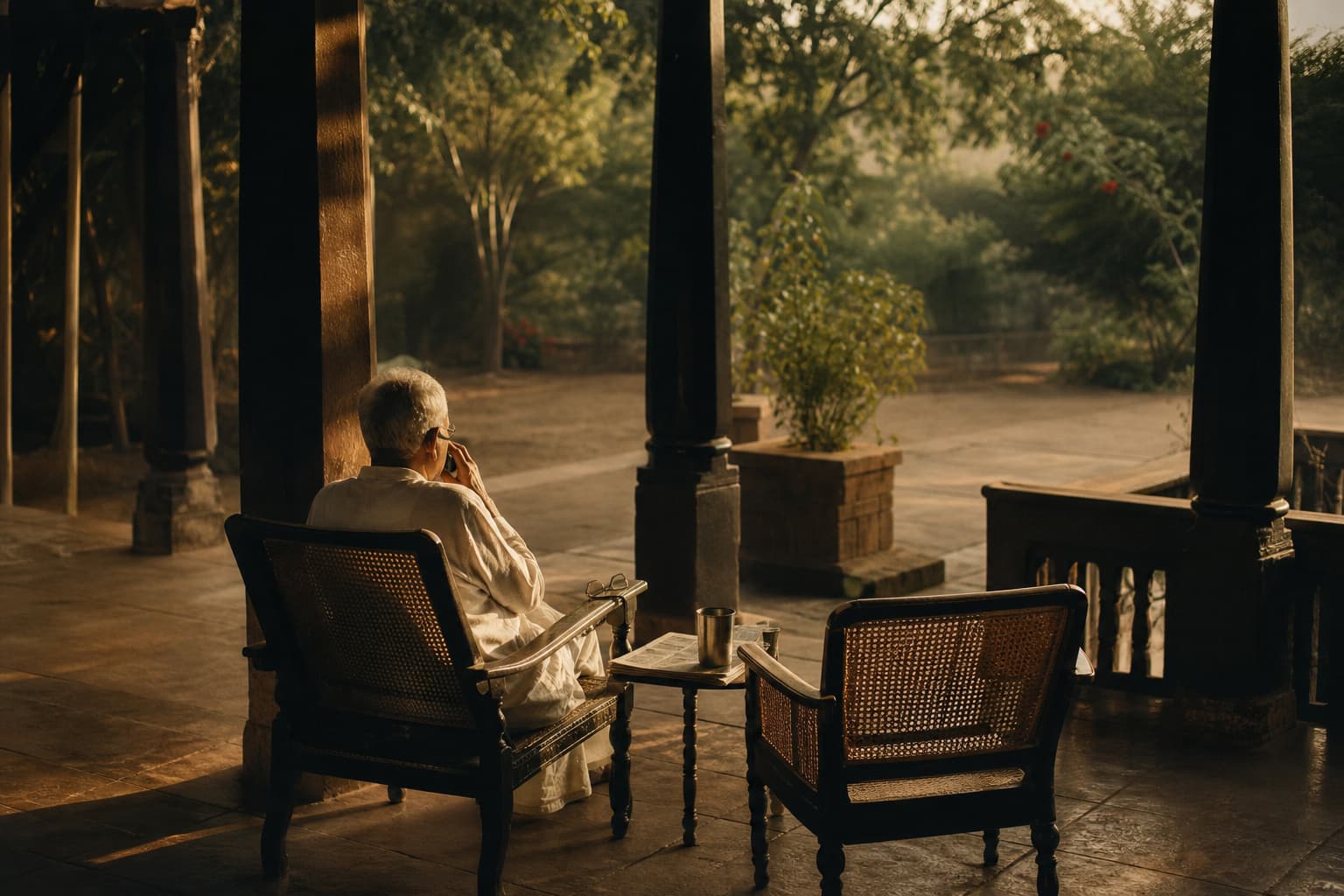
NRI guilt is the ache of building a life abroad while your parents grow old in India, and most of it worries about one thing: who will be there if something goes wrong. You can plan for that half, but only in part. Parents of NRIs describe a different loss. They say they feel less relevant. You can repair that half in full, from any time zone, and the repair is small: ask them something only they can answer.
I live in Amsterdam. My parents live in Delhi. When I left in 2019, they just told me to take care and follow my dreams. Last Diwali I asked them what they wanted, and the answer was "kuch nahi chahiye, tum aa jao bas": nothing, just come home. I couldn't go.
NRI guilt rehearses the phone call at the wrong hour
Ask an Indian abroad what the guilt is about and the answer comes back as a scene. The call at 2am. A fall you hear about after the X-ray. The day of flying between you and a hospital bed. The novelist Amitava Kumar, who came to the United States in the 1980s, wrote it down plainly in 2024: "So, that was the fear: the phone ringing at the wrong hour."
Researchers have a name for it. Jyotsna Kalavar and colleagues studied adult children in the US with mothers in India, through two focus groups and an online survey of 131 people, and heard "worry, sadness, guilt, and especially helplessness at their limited capacity to care for their mothers from a distance." They called it "in absentia caregiver stress".
Prerna Kohli, a clinical psychologist in Gurugram who counsels NRIs, explains why it never settles, however much you do from abroad: "It audits the absence, never the presence."
India has the largest diaspora in the world, 18 million people living outside the country of their birth in 2020, according to the UN. Almost every NRI knows this feeling, Kohli writes, and very few say it out loud.
NRI guilt keeps rehearsing one question: who will be there if something happens tonight.
An emergency plan lowers the risk, and the guilt stays
It is a fair question. About one-fifth of Indians over 60 "either live alone or only with the spouse and hence, must manage their material and physical needs on their own," according to the India Ageing Report 2023. The question has a real answer, and Kohli's list is the right one: one shared medical file, one named person nearby who can reach your parents first, and an agreement with your siblings made before a crisis, not during one.
Parents of NRIs built the same thing for themselves long ago. In 2006 the International Herald Tribune reported on Pune's NRI Parents' Organisation, then 950 members aged 60 to 95, split into small groups "with the younger charged with taking care of the older." Its treasurer, Nandkumar Swadi, explained what that buys: "there are always people able to rush and look after the needy, get them admitted to hospital, sit with them and take care of them until their children arrive."
Until their children arrive. Build the plan anyway. Then notice what it does to the feeling, which is very little. The plan lowers the risk to your parents. The guilt is measuring the distance, and no plan puts Delhi any closer to Amsterdam.
A good emergency plan protects your parents, and the guilt stays, because the guilt is measuring miles.
What parents of NRIs describe losing is relevance
The same 2006 report has a parent's own answer to the guilt. Padmakar Purandare, 68, a retired engineer whose son was a software engineer in Dallas, told the reporter: "My son feels that he should do more for me, but I don't. I'm happy he is there." A few paragraphs later the social historian Gitanjali Prasad, author of The Great Indian Family, named what parents like him were losing: "Now it's not that they feel unloved. They just feel they are becoming irrelevant, and they find that extremely painful."
Twenty years later the shape has not changed. In June 2026 the BBC visited TO Dominic, 70, in Kerala. One son lives in Karnataka and the other in the Middle East, and he starts most of his days with a call to one of them. The calls, the reporters wrote, are "comforting, revolving around familiar topics such as health and the weather."
The health questions are also the ones most likely to get a softened answer. The migration scholar Loretta Baldassar interviewed Italian migrants in Australia and their ageing parents in Italy, and found that "people think carefully about whether to tell faraway kin about health concerns or other personal difficulties so as not to 'worry' them". One woman she interviewed gave the second reason: "not to make them feel guilty". Her families were Italian, not Indian, but the habit will be familiar to anyone who heard about a parent's hospital visit after it was over. So the guilt shapes the call twice. It fills the call with health checks, and it teaches your parents to answer them gently.
My own calls run on two questions: "What did you have for dinner?" and "What are you doing this evening?" They tell me what they ate, and they are always watching TV.
Kohli's advice is to "ask about their day, not only their health." My two questions already ask about their day, and neither one reaches the years before I was born. A reply in a 2020 thread on Blind, where a 34-year-old engineer in the US asked whether to give up his life there for his parents, got closer: "Being intentional in conversations beyond the usual how are you, how is your health. Get to know them better (weird thought, but helpful I found in my life)."
Your guilt worries about your parents' safety; the loss they describe is relevance, and neither a health check nor a dinner check gives that back.
The only-them test: one question nobody else can answer
The check takes a minute, and you can run it before your next call. Look at the questions from your last three calls. For each one, ask whether a weather app, their doctor or anyone else in their house could have answered it. Both of mine fail, because either of my parents can answer them for the other. If every question on the call fails, the call kept your parent safe and told them nothing about how much they still matter to you.
Then ask one question that only they can answer:
- "Who walked you to school, and what was on the way?"
- "What did your mother say the day you left home?"
- "Was there a time you had to leave a place you loved?"
That last one is a question we wrote for Alfaaz in its first weeks, in March 2026, and the topic it belongs to draws the longest answers we record. Across our archive from March to 21 October 2026, a conversation that opened on a place (the house an elder grew up in, the street, a place they had to leave) drew a median of 730 words from the elder. A conversation that opened on family drew 471. Those are 20 and 36 conversations, from 6 and 13 elders, counted on 22 October 2026, leaving out tellers born in 1966 or later. It is a small closed beta, so read the order and not the totals.
A question only they can answer changes who holds the knowledge on the call. For twenty minutes your parent is the expert again, which is the exact position Prasad said they had lost.
A question only your parent can answer puts them back in the role that distance takes away: the one who knows.
What I still do not know about this guilt
Whether any of this makes the guilt smaller. Our numbers measure how much elders say when someone asks them, not how their children feel afterwards.
Or whether I will move back. I have had that thought on a lot of occasions, but I don't know when.
What I can say is where the regret lands in the account I trust most. Amitava Kumar paid the safety half in full. When his father was taken to hospital in Patna, his sister messaged him, he flew from New York, and he spent much of every day for a fortnight in the ICU. What he wrote afterwards was about the other half. "I can't claim I had had my say," he wrote. "If my father had been conscious, I suspect he would have a lot to tell me."
My parents have a lot to tell me too, and some of it I have heard only through Alfaaz, which they use. One thing was about money. When I was small, I wanted one very specific, very expensive pair of basketball shoes, and buying them disturbed the family's monthly budget. Neither of them had ever mentioned it on a call.
The emergency half of this guilt you can only plan for; the other half you can start on with a single question this week.
When did someone last ask your father something only he could answer?
If you want the asking to happen between your calls
Alfaaz (alfaaz.me) is a WhatsApp voice interviewer for Indian elders, and it does this asking for you. It sends your mother or father one spoken question at a time, in Hindi, Indian English, Marathi, Telugu, Bengali, Tamil, Gujarati or Punjabi. They answer with a voice note whenever they like, it follows up on what they actually said, and your family keeps their recordings next to written chapters. Your parent needs WhatsApp and nothing else, and how it works is short on purpose.
You can also do it by hand. Send one question this week as a voice note, about a place only they remember, and let them answer in their own language at their own hour.
A question that waits on your parent's phone gets answered in their own hour, not in the gap between your meetings.
Related reading: your parents are getting older: what to do now, the best gift for parents who live far away, and questions to ask your parents about their life.
Sources
- Prerna Kohli, "NRI Guilt About Aging Parents: The Pain of Loving From a Distance", June 2026.
- Kalavar, J. M., Zarit, S. H., Lecnar, C., and Magda, K. (2020). "I'm Here, You're There: In-Absentia Caregiver Stress & Transnational Support of Elderly Mothers by Adult Children". Journal of Intergenerational Relationships, 18(3), 320 to 338.
- Baldassar, L. (2008). "Missing Kin and Longing to be Together: Emotions and the Construction of Co-presence in Transnational Relationships". Journal of Intercultural Studies, 29(3), 247 to 266. The quotations are on page 253.
- IIPS and UNFPA, India Ageing Report 2023, page 35, from the LASI survey of 2017 to 2018.
- Amelia Gentleman, "Indian parents hit by empty-nest syndrome", International Herald Tribune, 30 October 2006. The quotations from Padmakar Purandare, Gitanjali Prasad and Nandkumar Swadi.
- Nikita Yadav and Ashraf Padanna, "This Indian state is trying to ensure no one grows old alone", BBC News, 25 June 2026.
- Amitava Kumar, "Amitava Kumar on Finding Solace in the Words of Others", Literary Hub, 27 February 2024.
- "Suffering from guilt for leaving behind aging parents alone back home", Blind, November 2020.
- UN DESA, International Migration 2020 Highlights. The 18 million figure.
- The Alfaaz Elder Conversations Study, the archive behind the opening-topic figures. Those figures are a fresh cut, counted on 22 October 2026 and logged with their method; the published study is the July 2026 edition. No transcripts, names or identifying details are ever published.
Common questions
Is it normal to feel guilty for living abroad while my parents age in India?
Yes, and it is common among the most attentive children. Prerna Kohli, a clinical psychologist who counsels NRIs, describes it as ambiguous loss, grief for a closeness you have lost with parents who are alive, and writes that "the NRIs who feel it most are usually the ones doing the most." India has the largest diaspora in the world, 18 million people in 2020 by the UN's count, so you are far from alone in it, even if few people say it out loud.
How do I stop feeling guilty about leaving my parents in India?
You probably will not stop it completely, so split it. One half worries about safety: who reaches your parents first in an emergency. Plan for that with one shared medical file, one named person nearby and an agreement with your siblings. The other half is about relevance, the loss parents of NRIs describe themselves. Repair that by asking them, on every call, at least one question that only they can answer, about their own life before you.
Should I move back to India to take care of my aging parents?
Make that decision on what your parents need and what they want, and ask them directly before you decide anything about them. Guilt alone is a poor guide in both directions. When the International Herald Tribune interviewed parents of NRIs in Pune in 2006, they did not blame their children for leaving, and one father said he was happy his son was abroad. Other parents do need a child nearby. Their answer and their health should decide it, not the feeling.
What should I talk about with my parents on calls from abroad?
Ask at least one question that a weather app, their doctor or anyone else in their house could not answer. Questions about a place work best: the house they grew up in, the street, a place they had to leave. In Alfaaz's own archive of recorded conversations with Indian elders, a conversation that opened on a place drew a median of 730 words from the elder, against 471 for one that opened on family (20 and 36 conversations, counted on 22 October 2026).