मराठी

All languages

Record your parents' stories in Marathi

Alfaaz speaks warm, everyday Marathi on WhatsApp, then keeps each answer as audio, transcript, and a growing family story.

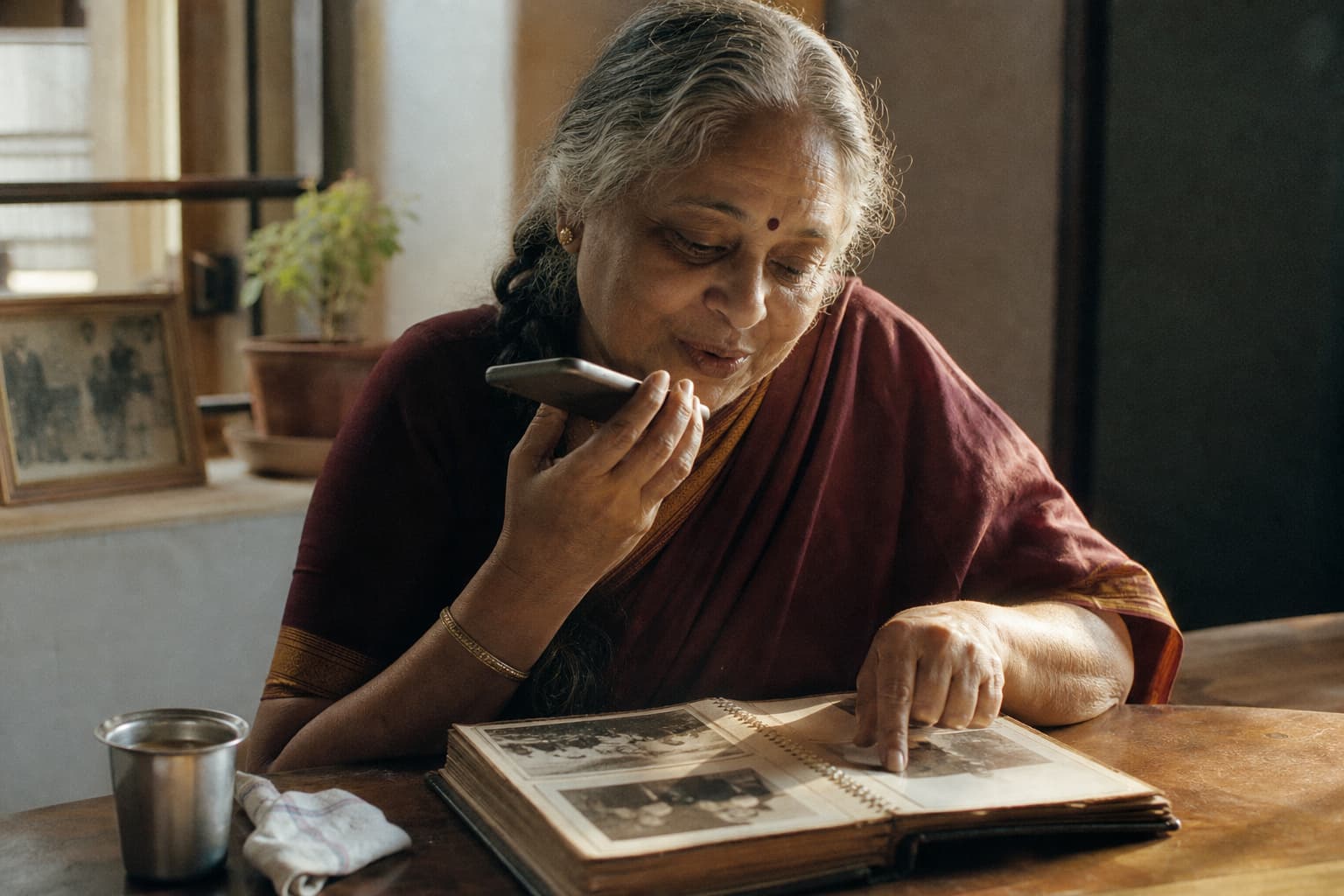
An Indian mother recording a Marathi family story as a voice note
One WhatsApp voice note. Their words, cadence, and voice preserved.

The direct answer

To record your parents' stories in Marathi, begin with the world around a memory rather than asking for a whole life at once. Alfaaz sends one spoken Marathi question on WhatsApp, follows what your parent actually says, and preserves the answer in their voice. There is no journal to fill and no new app to learn.

A life sounds different in Marathi.

तुम्ही जो आंब्याच्या झाडाचा उल्लेख केलात, आजोबांच्या अंगणात अजून काय उगवायचं, आणि त्याची काळजी कोण घ्यायचं?
Use the courtyard to recover the people and routines around it.

Spoken, not translated

Marathi warmth lives in register as much as vocabulary. A respectful तुम्ही, an easy “बोलूया,” and the rhythm of everyday speech can make a parent feel listened to. Stiff, over-Sanskritized Marathi can make the same question feel like an interview form.

Respect lives in the register

Alfaaz uses conversational Marathi in Devanagari, with the तुम्ही honorific and inclusive forms such as बोलूया and ऐकूया. It avoids Hindi-shaped phrasing when a natural Marathi construction exists, while still allowing the English words an elder already uses.

Follow the memory

Ask what only they can answer.

Specific questions unlock scenes. Relationship words keep every person in the right place.

तुम्ही जो आंब्याच्या झाडाचा उल्लेख केलात, आजोबांच्या अंगणात अजून काय उगवायचं, आणि त्याची काळजी कोण घ्यायचं?

Use the courtyard to recover the people and routines around it.

Relationships stay precise

Marathi family words need context. आजी and आजोबा can refer to either side of the family, unlike the dadi and nani split in Hindi. माहेर, सासर, वाडा, मावशी, आत्या, and काका each carry a place inside the family map. Alfaaz keeps that context across sessions instead of flattening every relation into “grandmother” or “uncle.”

The family's version stays intact

A Marathi life story often lives inside places as much as dates: the वाडा, the माहेर, the Ganpati room, the school ground, the first rented room in Pune or Mumbai. Those words are not decoration. They are coordinates for the next memory.

Less project. More conversation.

Your parent only speaks. Alfaaz carries the structure, memory, and archive.

Read the study

From first question to family archive

Choose their language
Alfaaz sends one spoken question
They reply with a WhatsApp voice note
The next question follows their answer
Start yourself with one concrete memory. Let them answer fully in Marathi, then label the people and places while the context is fresh.

1,347 real replies

93%

of elder replies arrived as voice notes

2.1×

more words from an emotional question than a factual one

797

people, places, events, and things remembered

Keep more than a transcript

Original audio
Transcript and context
A growing family memoir

Common questions

Can Alfaaz record my parents' stories in Marathi?

Yes. Marathi (मराठी) is live in Alfaaz today. Your parent receives spoken questions on WhatsApp, replies with voice notes, and every answer is kept as original audio with a transcript and story summary.

Does my parent need to type in Marathi?

No. Alfaaz is voice-first. Your parent listens to a WhatsApp voice note and answers by speaking. Typing is supported, but it is not required.

Will Alfaaz preserve the original Marathi recording?

Yes. The original voice note stays attached to the story in the family archive. The transcript does not replace the recording.

Does my parent need to install an Alfaaz app?

No. The family member sets Alfaaz up. The parent only uses WhatsApp, with no Alfaaz account, password, camera, or new app.