हिन्दी

All languages

Record your parents' stories in Hindi

Alfaaz interviews them on WhatsApp in natural Hindi or Hinglish and keeps every answer in their original voice.

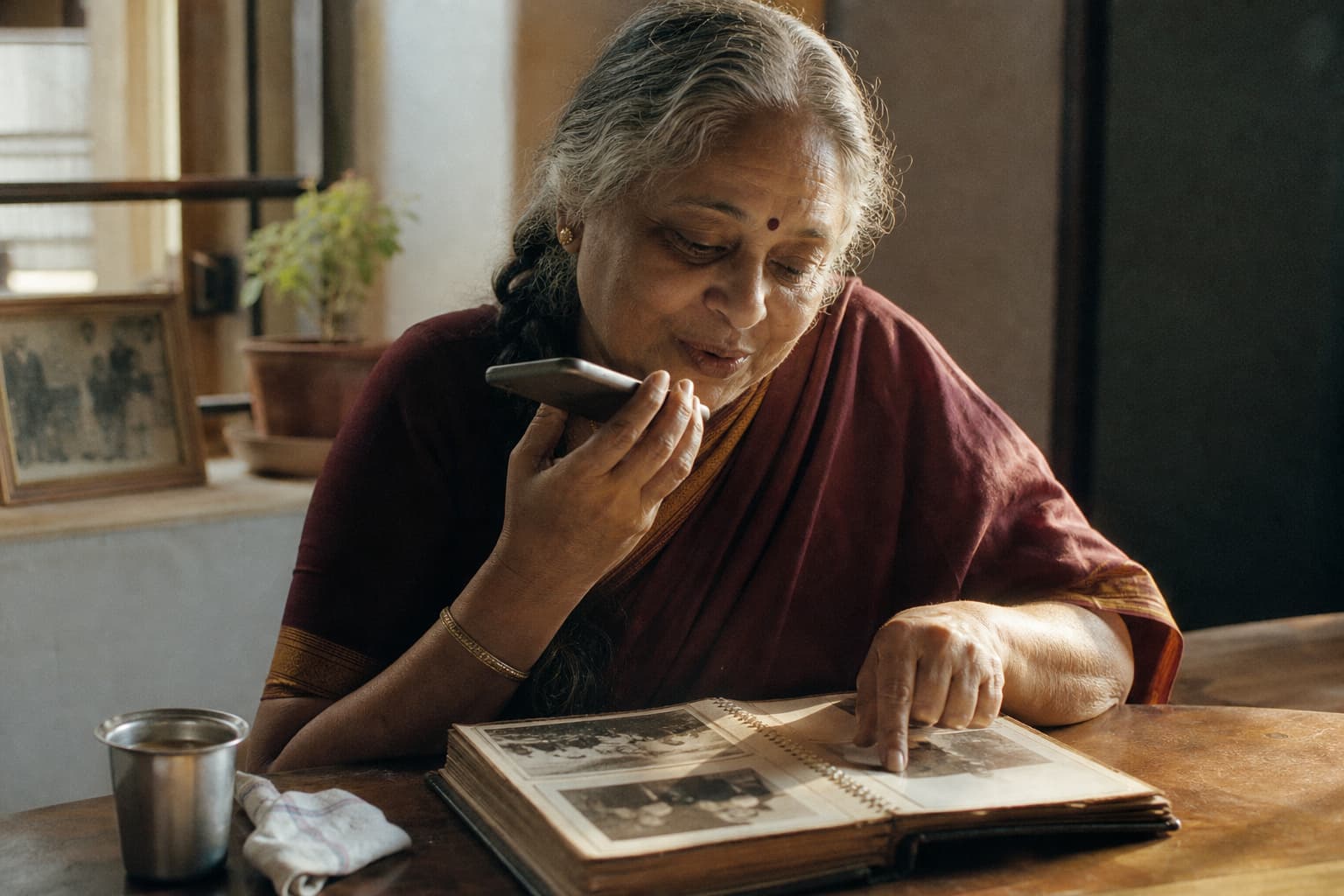
An Indian mother recording a Hindi family story as a voice note
One WhatsApp voice note. Their words, cadence, and voice preserved.

The direct answer

The easiest way to record your parents' stories in Hindi is to ask one specific question at a time, let them answer by voice, and keep both the recording and its context. Alfaaz does this over WhatsApp: it sends a gentle Hindi voice-note question, listens to the answer, asks the natural follow-up, and saves the original audio beside the growing story.

A life sounds different in Hindi.

आपने जो आम के पेड़ की बात की, दादाजी के आंगन में और क्या उगता था, और उसकी देखभाल कौन करता था?
Return to the mango tree, then ask who cared for the rest of the courtyard.

Spoken, not translated

Hindi family memories rarely stay inside formal textbook Hindi. A story can move from दादी to school, from मोहल्ला to office, and from a village nickname to an English place name in one answer. Alfaaz expects that movement instead of treating it as an error.

Respect lives in the register

The Hindi interviewer writes in Devanagari so the spoken question sounds right, while leaving natural English names and words intact when the elder uses them. It is instructed to sound conversational, not literary. In Alfaaz's recorded conversation study, 79% of Hindi replies included at least one English word.

Follow the memory

Ask what only they can answer.

Specific questions unlock scenes. Relationship words keep every person in the right place.

आपने जो आम के पेड़ की बात की, दादाजी के आंगन में और क्या उगता था, और उसकी देखभाल कौन करता था?

Return to the mango tree, then ask who cared for the rest of the courtyard.

Relationships stay precise

Hindi kinship words carry information that English loses. दादी and नानी point to different sides of the family; बुआ, मौसी, चाचा, and मामा are not four interchangeable versions of “aunt” or “uncle.” Alfaaz stores those relationship cues so later questions can return to the right person.

The family's version stays intact

A Hindi memoir should keep the words a family actually uses: the pet name only siblings remember, the exact way a parent says “हमारा पुराना घर,” and the switch into English when work or school enters the story. Polishing all of that into formal prose would make the record less true.

Less project. More conversation.

Your parent only speaks. Alfaaz carries the structure, memory, and archive.

Read the study

From first question to family archive

Choose their language
Alfaaz sends one spoken question
They reply with a WhatsApp voice note
The next question follows their answer
Start yourself with one concrete memory. Let them answer fully in Hindi, then label the people and places while the context is fresh.

1,347 real replies

93%

of elder replies arrived as voice notes

2.1×

more words from an emotional question than a factual one

797

people, places, events, and things remembered

Keep more than a transcript

Original audio
Transcript and context
A growing family memoir

Common questions

Can Alfaaz record my parents' stories in Hindi?

Yes. Hindi (हिन्दी) is live in Alfaaz today. Your parent receives spoken questions on WhatsApp, replies with voice notes, and every answer is kept as original audio with a transcript and story summary.

Does my parent need to type in Hindi?

No. Alfaaz is voice-first. Your parent listens to a WhatsApp voice note and answers by speaking. Typing is supported, but it is not required.

Will Alfaaz preserve the original Hindi recording?

Yes. The original voice note stays attached to the story in the family archive. The transcript does not replace the recording.

Does my parent need to install an Alfaaz app?

No. The family member sets Alfaaz up. The parent only uses WhatsApp, with no Alfaaz account, password, camera, or new app.